

Cybersecurity has become a fundamental business requirement rather than a technical concern reserved for large enterprises. Modern companies depend on websites, cloud applications, APIs, online payment systems, customer databases, and remote-access tools to operate efficiently. Unfortunately, every connected system can also create a potential entry point for cybercriminals. This is why organizations are increasingly looking beyond traditional vulnerability scanning and exploring pentest AI solutions that can identify and validate security weaknesses before malicious attackers exploit them.
One example of this evolving approach is AI penetration testing from BackDoor, which combines automated offensive security techniques with vulnerability validation and human review. Rather than simply generating a long list of possible security issues, modern AI-driven penetration testing aims to determine which weaknesses can actually be exploited and what impact they could have on a business. BackDoor describes its approach as black-box testing from an external attacker’s perspective, with findings supported by working proof-of-concept evidence.
What Is AI Penetration Testing?
AI penetration testing is the use of artificial intelligence and automated security agents to examine digital systems for exploitable vulnerabilities.
Traditional vulnerability scanners normally compare software, configurations, and services against known security signatures. They can be useful for identifying potential weaknesses, but their results may include false positives or vulnerabilities that are difficult to exploit in a real-world environment.
A pentest AI platform attempts to go further.
Instead of only asking, “Could this system contain a vulnerability?” AI-assisted penetration testing attempts to answer a more important question:
“Can an attacker actually exploit this weakness, and what could happen if they do?”
The process can involve:
- Attack-surface discovery
- Domain and subdomain analysis
- Web application testing
- API security testing
- Authentication testing
- Access-control assessment
- Injection testing
- Exposed-service discovery
- Security misconfiguration analysis
- Vulnerability validation
- Proof-of-concept generation
- Risk prioritization
This approach can help security teams distinguish theoretical risks from weaknesses that may create genuine business exposure.
Why Traditional Security Scanning Is Not Always Enough
Automated vulnerability scanners remain an important component of cybersecurity programs. However, a scanner and a penetration test serve different purposes.
A scanner might detect an outdated component or suspicious configuration and mark it as potentially vulnerable. A penetration test investigates whether that weakness can actually be used to gain unauthorized access, expose information, bypass controls, or compromise another part of the system.
This distinction becomes especially important for businesses operating complex websites and applications.
Consider an online platform containing:
- Customer accounts
- Administrative dashboards
- Payment functionality
- APIs
- File uploads
- Password-reset systems
- Subscription management
- Internal integrations
A simple scanner may identify individual weaknesses. A penetration tester may instead examine how several smaller weaknesses could be combined into a more serious attack path.
That ability to validate risk is one reason businesses are becoming interested in pentest AI technology.
How Pentest AI Changes the Security Testing Process
Artificial intelligence can help security testing systems perform repetitive attack-surface analysis more quickly while exploring multiple potential paths.
Faster Attack-Surface Discovery
Modern businesses often maintain more internet-facing infrastructure than they realize.
A company may have:
- Primary websites
- Development environments
- Staging servers
- Forgotten subdomains
- Public APIs
- Cloud services
- Administration portals
- Third-party integrations
AI-assisted tools can examine these assets systematically and help identify areas that deserve further investigation.
Parallel Security Testing
Human penetration testers usually work within limited engagement periods. AI agents can potentially test multiple areas of an application simultaneously.
BackDoor, for example, describes an autonomous model in which multiple AI agents investigate an external attack surface and attempt to validate vulnerabilities using working exploits.
This does not necessarily eliminate human security professionals. Instead, automation can handle portions of reconnaissance, testing, and validation while security experts concentrate on more complex problems.
Black-Box Testing and the Attacker’s Perspective
One valuable penetration-testing methodology is black-box testing.
In black-box testing, the tester initially approaches a system without access to its source code or internal infrastructure. The objective is to simulate what an external attacker could discover.
This matters because attackers rarely begin with complete knowledge of a company’s environment.
They typically begin by examining publicly accessible systems.
A black-box pentest may investigate:
- Public forms
- Login pages
- APIs
- Subdomains
- Open ports
- Exposed services
- Authentication mechanisms
- Password-reset workflows
- File-upload features
BackDoor states that its default autonomous testing begins externally, without requiring source-code or server access, and can also extend testing behind authentication when approved test accounts are provided.
The Importance of Exploit Validation
One of the biggest problems in vulnerability management is prioritization.
A company might receive hundreds of security alerts, but its technical team may have limited time to investigate them.
Without proper validation, teams can spend significant resources fixing low-risk findings while a genuinely exploitable vulnerability remains unresolved.
This is where exploit validation becomes useful.
A validated finding may demonstrate:
- Where the weakness exists.
- How it can be exploited.
- What level of access it provides.
- What business data or systems could be affected.
- How the organization should remediate the issue.
BackDoor says its AI pentesting model attempts to demonstrate findings with working proof-of-concept exploits before they appear as validated vulnerabilities, with security engineers reviewing reports to reduce false positives.
Human Penetration Testing Still Matters
AI should not be viewed as a universal replacement for professional penetration testers.
Certain security problems require contextual understanding and creative reasoning that may benefit significantly from human investigation.
Examples include:
Business Logic Vulnerabilities
A business process may function exactly as programmed while still allowing abuse.
For example, a user might discover a sequence of legitimate actions that allows unauthorized discounts, duplicated refunds, privilege escalation, or access to another customer’s data.
Complex Authorization Problems
Applications with several user roles can contain subtle authorization weaknesses involving administrators, customers, employees, partners, or vendors.
Multi-Step Attack Chains
Some vulnerabilities become dangerous only when combined with other weaknesses.
A human security professional may recognize relationships between findings that are difficult to detect through conventional automated scanning.
For this reason, a mature security strategy can combine pentest AI with manual penetration testing.
BackDoor itself currently provides both autonomous AI penetration testing and human-led testing, positioning manual testing for areas such as business logic, access control, attack chains, and assessment requirements.
AI Pentesting for Modern Business Security
Security incidents can affect far more than an IT department.
A serious breach may cause:
- Service interruption
- Customer-data exposure
- Financial losses
- Regulatory problems
- Reputation damage
- Customer churn
- Recovery expenses
- Contractual disputes
For this reason, penetration testing should also be considered part of broader business-risk management.
A technical vulnerability in a login system, for example, could become a business problem if attackers access customer accounts.
A vulnerable API could expose confidential information.
An insecure administrative interface could allow unauthorized configuration changes.
Understanding these relationships helps executives prioritize cybersecurity investments based on business impact rather than technical severity alone.
Pentest AI and Continuous Security Testing
Traditional penetration tests are often performed periodically.
A company might conduct one before an important launch or once or twice each year.
The problem is that software changes continuously.
Developers release new features. APIs change. Plugins are updated. Infrastructure moves. Cloud services are connected. New integrations are introduced.
Every meaningful change can alter the attack surface.
AI-assisted penetration testing can make more frequent security assessments practical because portions of testing can be automated.
This creates the possibility of moving from periodic security assessments toward more continuous validation.
Organizations might perform testing:
- Before major releases
- After significant application changes
- After infrastructure migrations
- After new API deployments
- Before compliance reviews
- Following vulnerability remediation
- At scheduled security intervals
The goal is simple: discover dangerous weaknesses before attackers do.
Turning Security Findings Into Action
Finding vulnerabilities is only the beginning.
A useful penetration test should help organizations understand how to fix them.
An effective security report should ideally provide:
Clear Risk Prioritization
Teams should understand which vulnerabilities require immediate attention.
Technical Evidence
Developers need enough information to understand why the vulnerability exists.
Reproduction Information
Security and engineering teams should be able to verify the problem in a controlled environment.
Remediation Guidance
Reports should explain practical steps for reducing or eliminating the risk.
Retesting
After remediation, organizations should verify that the vulnerability has actually been resolved.
BackDoor says its reports include prioritized findings, proof-of-concept evidence, remediation guidance, and retesting options, while also providing executive-level and engineering-focused reporting.
Pentest AI vs. Vulnerability Scanning
Although the technologies overlap, their objectives are different.
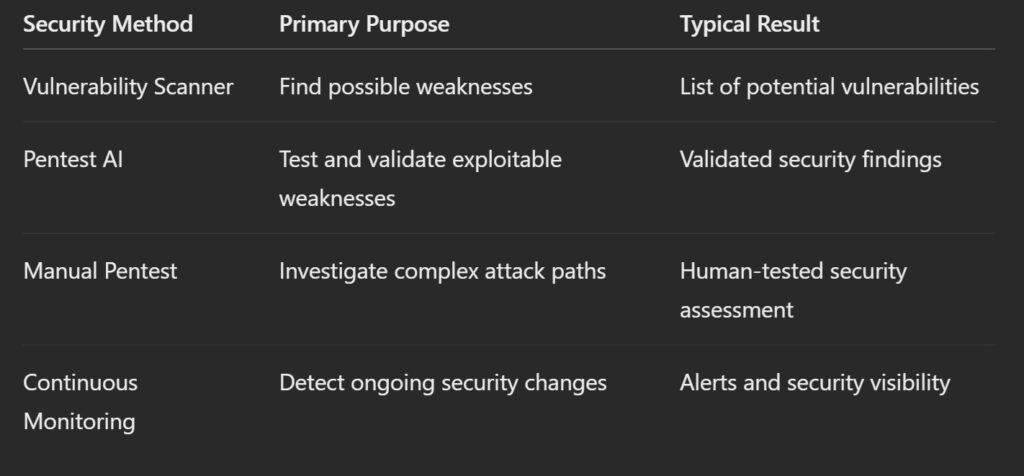
Automated scanning provides broad visibility. AI penetration testing validates exploitable weaknesses. Human testers investigate complex scenarios. Continuous monitoring helps organizations identify new changes over time.
Building a Better Cybersecurity Strategy
Technology alone cannot protect an organization.
Effective cybersecurity also depends on policies, development practices, employee awareness, monitoring, and incident-response planning.
Businesses should consider combining penetration testing with:
- Multi-factor authentication
- Secure software development
- Regular patching
- Access-control reviews
- Data encryption
- Security logging
- Employee security training
- Backup strategies
- Incident-response planning
- Third-party risk management
Pentesting becomes especially valuable when it is integrated into this wider security program.
Instead of treating a pentest as a one-time compliance exercise, organizations can use the results to continuously improve their defensive posture.
The Future of AI-Driven Penetration Testing
Artificial intelligence is likely to become increasingly integrated into cybersecurity operations.
AI can help security teams analyze larger attack surfaces, automate repetitive tasks, identify unusual patterns, and validate security findings more efficiently.
At the same time, skilled human security professionals remain important for understanding business context, complicated authorization models, unusual application workflows, and sophisticated attack chains.
The future of penetration testing is therefore unlikely to be simply AI versus humans.
A more practical model is AI plus human expertise.
AI can provide speed, scalability, and continuous coverage, while security professionals contribute judgment, creativity, strategic analysis, and deeper investigation.
Conclusion
Cyber threats continue to evolve alongside the technologies businesses use every day. Websites, APIs, cloud infrastructure, customer portals, and online services create enormous opportunities for organizations, but they also expand the potential attack surface.
Pentest AI provides a new way to approach this challenge by combining automation with active vulnerability validation. Instead of relying entirely on theoretical security warnings, businesses can focus more attention on weaknesses that demonstrate genuine exploitability.
Platforms such as BackDoor illustrate how AI-assisted black-box testing, proof-of-concept validation, security reporting, and human review can become part of a modern penetration-testing strategy. Combined with manual testing and broader security controls, these technologies can help businesses identify vulnerabilities earlier, prioritize remediation more intelligently, and strengthen security before real attackers have the opportunity to exploit weaknesses.
For modern organizations, penetration testing is no longer simply about proving that a security assessment was completed. Its real value lies in understanding where meaningful risk exists—and fixing it before that risk becomes a security incident.